
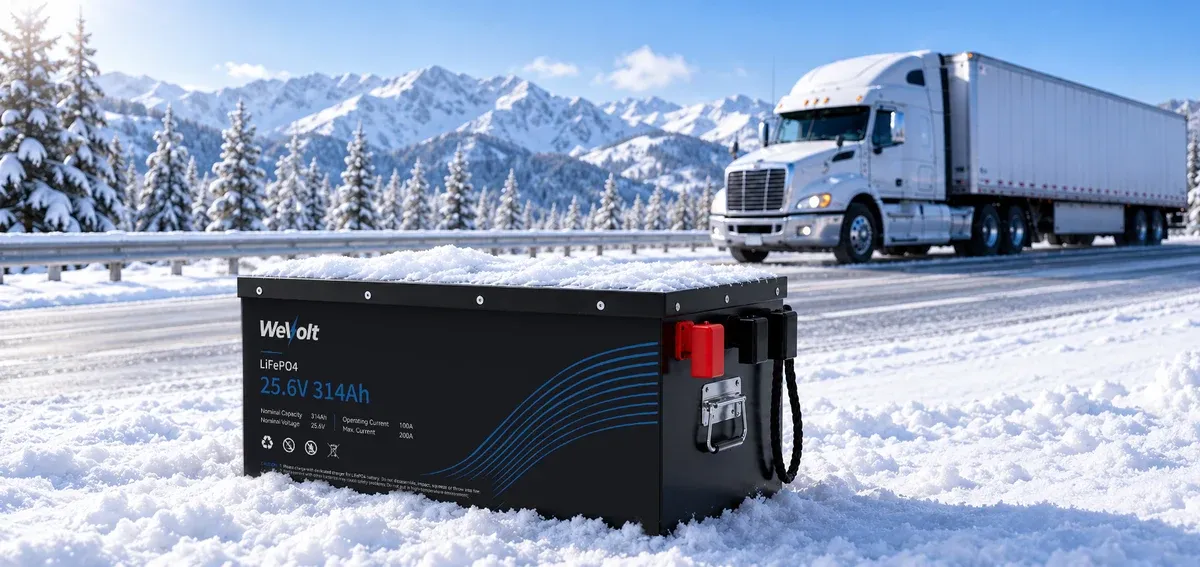
After you shut the engine off, the A/C, fridge, phone charger, and cab lights keep drawing power. If all of that hangs on the starter battery, one night can drain it flat and leave you unable to start in the morning. A dedicated parking battery, also called an auxiliary battery, keeps those "hotel loads" separate from your starting power. This article explains WeVolt's 24V 314Ah lithium auxiliary battery: what it is, whether it runs a full night, how it behaves in winter, and how it actually relates to your starter battery.
Introduction: why a truck needs a dedicated parking battery
When the truck is parked with the engine off, the cab does not stop consuming power. The parking air conditioner, onboard fridge, lighting, phone charging, and inverter-powered devices are all loads that keep drawing after the engine stops. If those loads sit directly on the starter battery, the best case is a weak start the next morning; the worst case is a deeply discharged starter that has to be replaced early.
The fix is a separate parking battery, also called an auxiliary battery, that carries the hotel loads while the starter battery handles cranking and driving electrics. This article focuses on the WeVolt 24V 314Ah unit: the storage core of the WeVolt Apex eAPU system. We walk from the definition and specifications, through the voltage choice and chemistry comparison, to whether it runs a full night, how it handles winter, and exactly how it coexists with your starter battery.
What this battery is
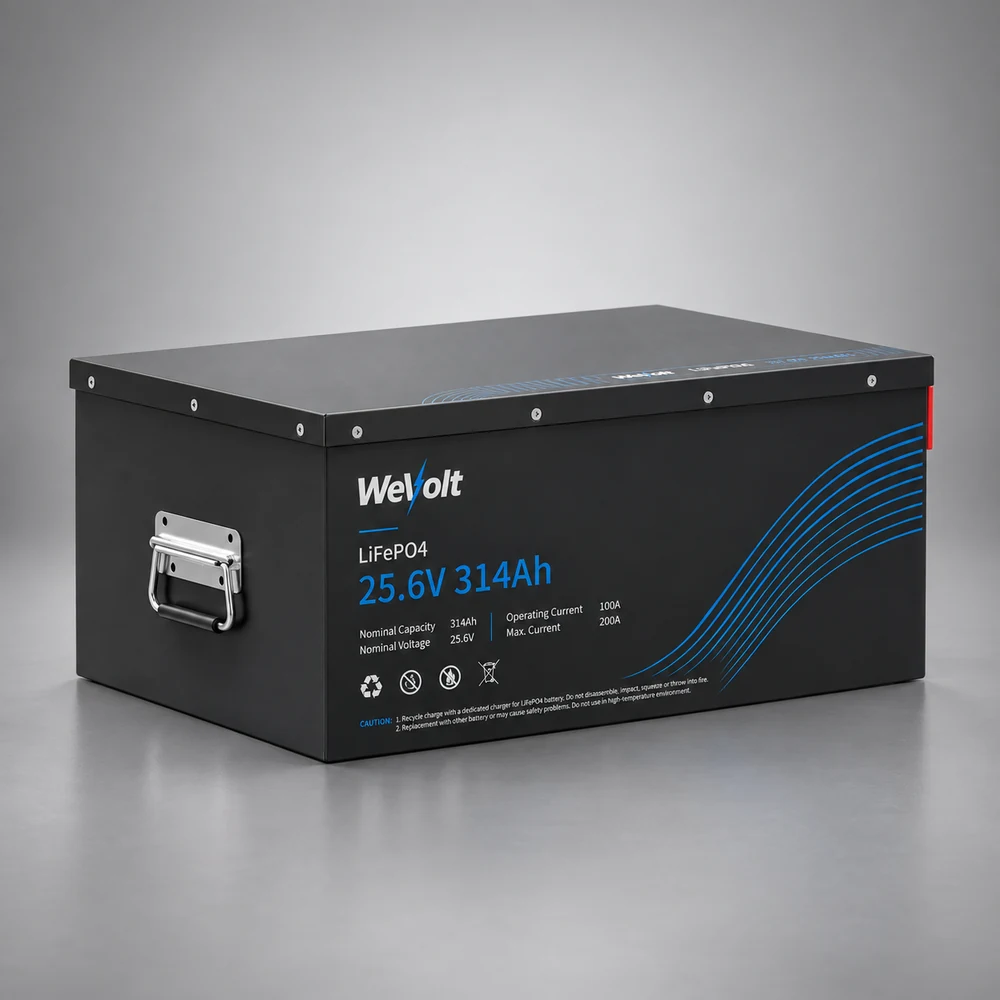
Model WeVolt WTTB-24V-314Ah is a 25.6V / 314Ah lithium auxiliary battery using LiFePO₄ cells, with a nominal energy of 8.04kWh (25.6V × 314Ah). It uses EV-grade cells and is built for the overnight hotel loads of a semi truck eAPU system. As a semi truck battery, its job is to power the cab through the night without running the main engine.
Its design philosophy is "More Energy per Liter, Less Hardware per Truck": pack a full night of energy into a more compact enclosure, so you need less space, less cabling, and fewer connection points on the vehicle. Inside the system it is the energy storage module, not a starter battery.
Throughout this article, the positioning stays "parking / auxiliary battery." It plays a different role from the starter battery, and the later section spells out that relationship so it is not misused.
Key specifications at a glance
Below are the confirmed parameters, so you can quickly judge whether it is enough and whether it fits.
Cycle life and weight are given in the factory datasheet. The enclosure, protection rating, energy density, and self-heating are confirmed values; for the exact cycle count and net weight, see the formal product page or request the test report.
Why 24V, not 12V
For the same 1,000W load, doubling the voltage halves the current. Against a 12V setup, the 24V platform delivers concrete benefits:
- Thinner cabling: with half the current, the main run can use noticeably smaller-gauge wire, saving weight and simplifying routing.
- Less heat: line loss falls with the square of the current, so the high-current paths on 24V stay cooler and terminal overheating is less likely.
- Fewer connection points: one large-capacity pack (314Ah) replaces several small batteries in parallel, removing a layer of parallel balancing and terminals, and with it a set of failure points.
- A system-level decision: the WeVolt Apex eAPU is designed entirely around 24V. The battery, air conditioner, charger, and inverter share one voltage platform instead of mixing 12V and 24V logic.
Choosing 24V is not an arbitrary voltage; it is the result of balancing current, wire gauge, volume, and reliability across the whole eAPU. Wire gauge and fusing are a separate installation calculation and are not covered here.
LiFePO4 vs AGM: choosing for parking use
Two chemistries dominate parking batteries: traditional AGM (a type of lead-acid) and lithium iron phosphate (LiFePO₄). Neither is universally better; it depends on how you use the truck.
If your loads are light, you want a simple swap, and the budget is tight, AGM remains a reasonable choice. If you run the A/C all night, want to save weight, and care about the long-term math (fewer replacements, less downtime), a lithium battery for truck use wins clearly. The rule is simple: size it to your real load and duty cycle, not to the highest number on a spec sheet.
All-night power: does 8.04kWh cover a night?
Whether 8.04kWh lasts the night depends on what you actually run after dark. Using the matched parking air conditioner of the WeVolt Apex eAPU as the example:
- Cooling draws about 900W from the battery, plus roughly 100–200W for fridge, lights, and charging, for a total around 1,000–1,100W.
- At the nominal 8.04kWh, cooling loads run about 6–8 hours (after a safety margin and conversion losses).
- Heating uses about 1,600W from the PTC element, so the same load lasts only about 4–5 hours; it drains noticeably faster.
The system enforces a shared battery limit of 157A continuous / 200A peak. When planning, keep the air conditioner and inverter from both hitting full load at the same time and breaching that ceiling. The quick formula is: runtime ≈ 8.04kWh ÷ total overnight power, with temperature, heating, and inverter loads plugged in.
Do not overstate cold weather: on routes that sit below zero, heating drains the pack faster and runtime shrinks. WeVolt backs this with an optional diesel auxiliary heater; we do not claim one battery covers the entire year in every climate. On extreme-cold routes, budget that supplemental heating into your power plan.
Cold weather: self-heating and low-temperature charge protection
Northern winters are where lithium is most often misunderstood. Charging LiFePO₄ cells when they are too cold causes lithium plating and permanent damage. This battery has two cold-weather defenses:
- Low-temperature charge protection: when cell temperature drops below the safe charging window, charging is disabled automatically, preventing cold-charge damage at the root.
- Automatic self-heating: built-in heating warms the cells back to a safe charging temperature on its own, with no external heater required.
Paired with the steel enclosure and IP65 rating built for continuous road use, the logic is "protect itself when cold, warm up, then work" rather than pushing through. For cold-region drivers, these two features matter more than a bare capacity number.
It is not a starter battery: its real relationship with your starter
This is the most confused point and the one worth stating plainly: the WeVolt 24V 314Ah is a lithium auxiliary battery for parking use, not a starter battery, and it does not replace the starter battery.
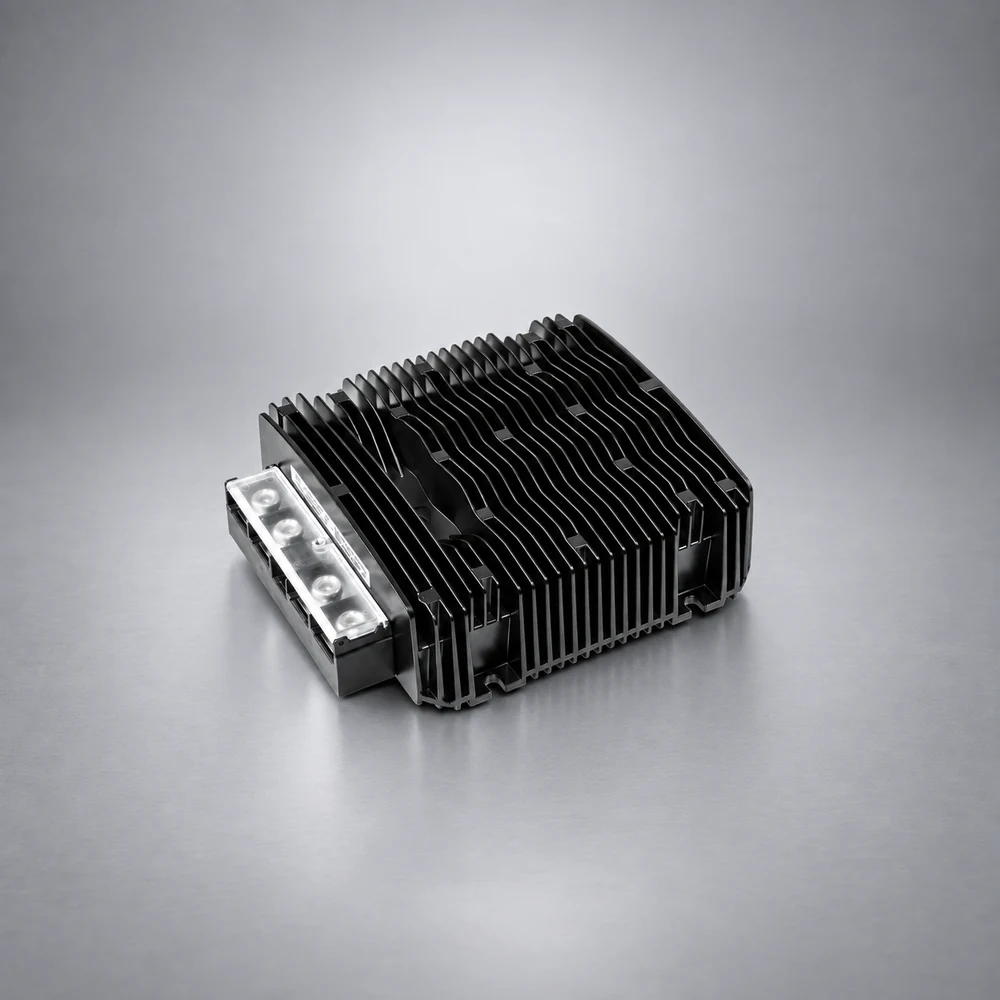
It connects to the truck's 12V starter battery through a bidirectional DC-DC charger. While driving, the DC-DC charges this 24V parking battery (forward up to 29.2V/50A). After parking, the DC-DC reverses and tops up the 12V starter battery (reverse up to 14.4V/100A). The purpose is to keep the starter battery from being drained flat by hotel loads and failing to start in the morning, not to use the parking battery as a substitute for starting.
Do not use it as a starter battery: it carries no cold-cranking (CCA) rating and does not handle cranking. Some batteries market a dual-purpose design with starting current; that is a different product route. WeVolt chose an honest auxiliary positioning, which buys the trust of "does not harm your original starter battery" instead of overstating a job it does not do.
Keeping hotel power and starting power separate is already standard practice for long-haul trucks. The value of this battery is doing that one job well and reliably, rather than trying to do everything.
Inside the eAPU system: how it works with the A/C, charger, and inverter
On its own it is a battery; inside the system it is one link of the WeVolt Apex eAPU. The set has four parts:
- Parking battery (this article's subject): stores 8.04kWh, discharges after the engine stops.
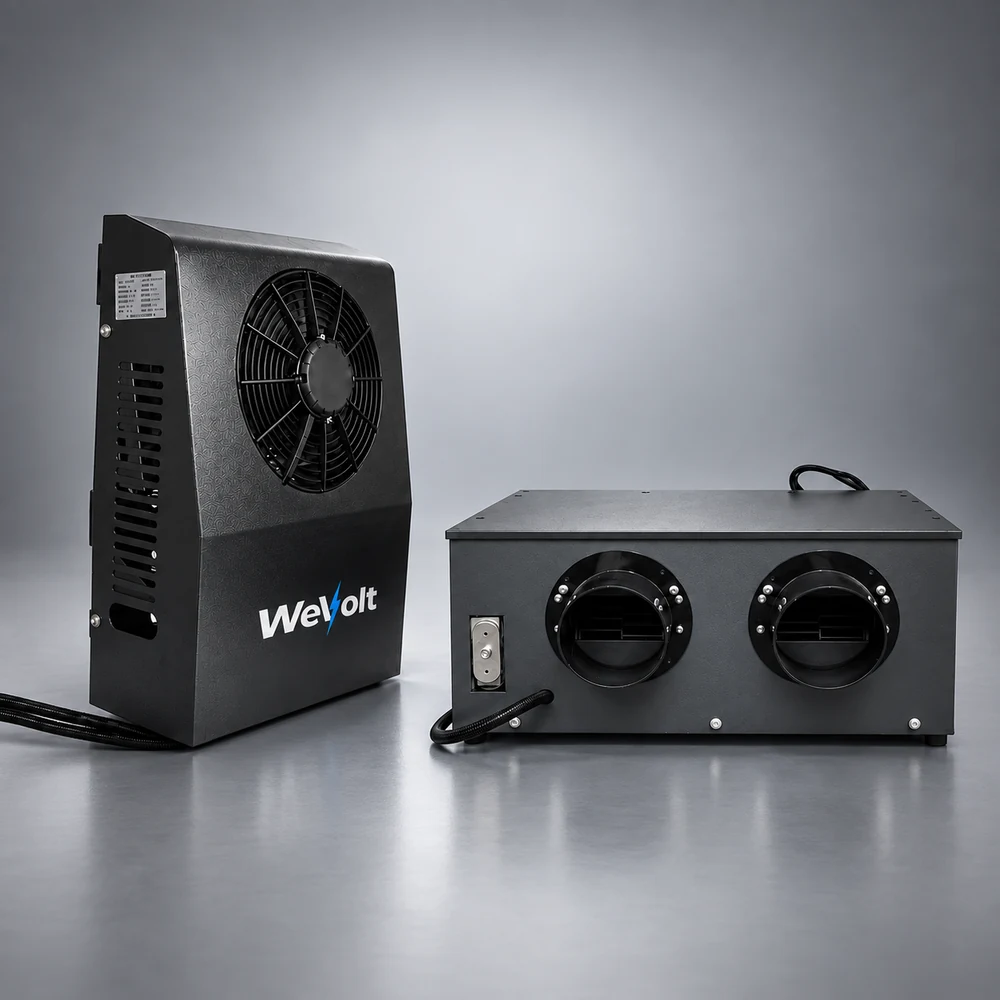
- Parking air conditioner: about 900W cooling / 1,600W heating, drawn from the battery.
- Bidirectional DC-DC charger: charges while driving, refills the starter after parking (forward up to 29.2V/50A, reverse up to 14.4V/100A).
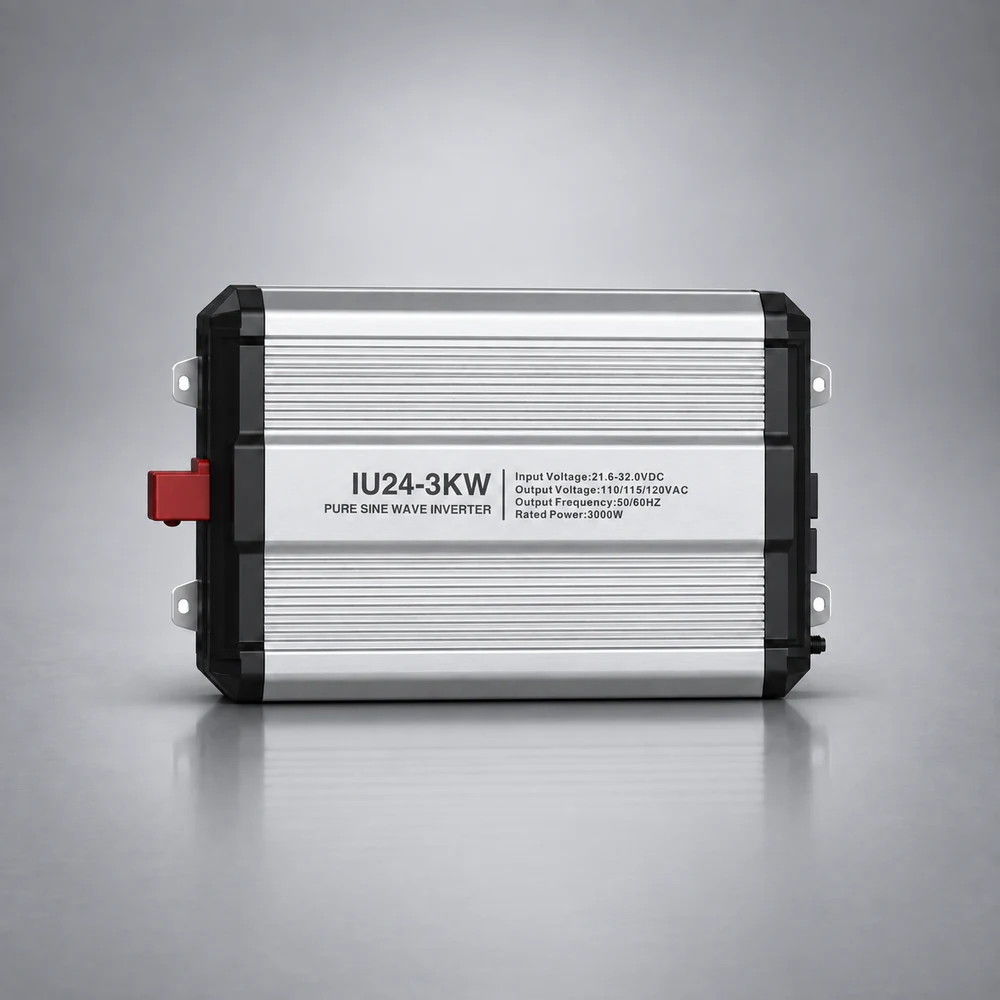
- Pure sine wave inverter: turns 24V DC into 120V AC for laptops, rice cookers, and other mains devices.
These four are matched and validated on one 24V platform before they leave the factory; you are not expected to source four vendors and piece them together. A seller that ships only a loose battery delivers cells; a seller that ships a validated system delivers "the cab has power all night" with confidence. Count that difference when you choose, because it matters more than comparing one battery's capacity in isolation.
To see how each matched component is selected and installed, read the parking air conditioner, the bidirectional DC-DC charger, and the pure sine wave inverter product pages, or the WeVolt Apex eAPU system overview.
Summary and next steps
The WeVolt 24V 314Ah parking battery centers on an 8.04kWh EV-grade LiFePO₄ pack: a 200A JK BMS, IP65 steel enclosure, a compact 500×345×230mm footprint, and low-temperature charge protection with automatic self-heating. In the eAPU system it stores energy and supplies the overnight hotel loads after the engine stops.
Three points to remember: first, it is an auxiliary battery, not a starter, and the DC-DC reverse path only keeps the starter from going flat; second, whether it covers a night is your own "8.04kWh ÷ total overnight power" calculation, and heating plus extreme cold drain it faster; third, winter relies on self-heating, with extreme-cold routes adding diesel auxiliary heating, and we do not overstate one pack covering everything.
To go further:
WeVolt Apex 24V eAPU system overviewMatched components: parking A/C, DC-DC charger and inverterQuote and component selection: [email protected]
References
- WeVolt product data: WTTB-24V-314Ah parking lithium battery (25.6V / 314Ah / 8.04kWh, 200A JK BMS, IP65, steel enclosure, 500×345×230mm, 203 Wh/L, low-temperature charge protection + self-heating).
- WeVolt Apex eAPU system overview: storage module 25.6V/314Ah/8.04kWh, EV-grade cells, 157A continuous / 200A peak shared limit; bidirectional DC-DC forward up to 29.2V/50A, reverse up to 14.4V/100A.
- WeVolt C-Series component manual: parking air conditioner (about 900W cooling / 1,600W heating), bidirectional DC-DC charger, pure sine wave inverter model and parameters.
- Voice of Customer core advantages: all-night power, higher energy per volume, IP65 plus vibration resistance built for trucks, explicit "parking, not starting" positioning.
This article is a product description. Exact cycle life, weight, and installation fit are per the formal datasheet or our confirmed reply. Legal entity and registered address are per the official publication page.
How the pack performs on a real overnight runFull battery specs and the shared 157A limit