
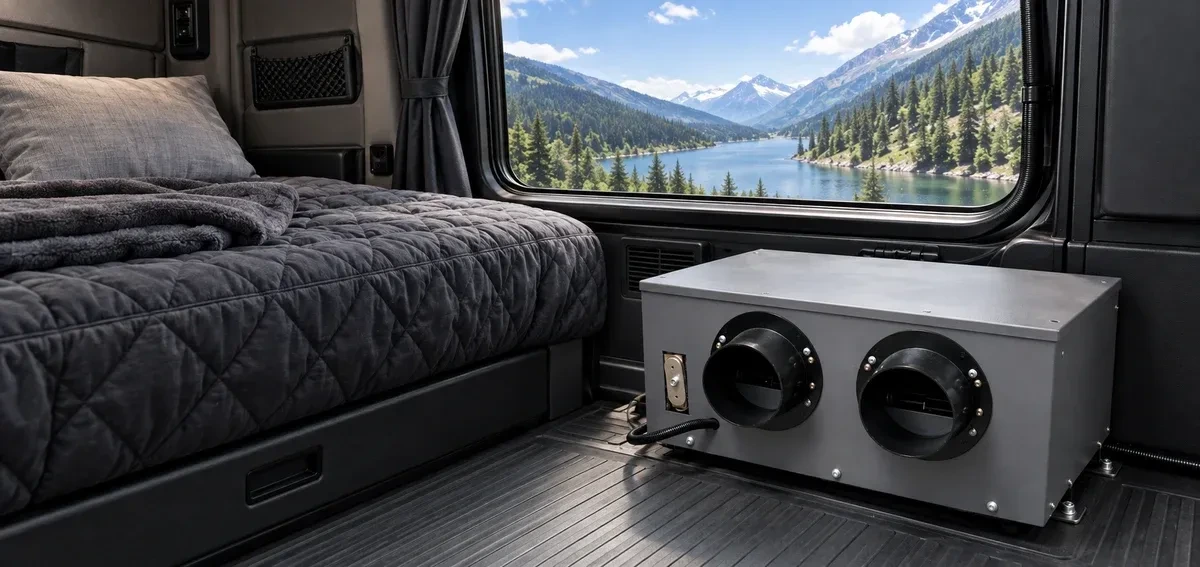
Under the U.S. HOS rule, a long-haul driver must take a continuous 10-hour off-duty rest with the engine off. To keep the bunk cool, many drivers idle the engine, burning gallons of diesel a night, risking an anti-idling citation, and sleeping on their own engine noise. The answer most drivers land on is an air conditioning for semi trucks setup that draws from an auxiliary battery, so the engine stays off and the bunk stays cool all night. This article works through the two numbers that actually decide whether a setup is safe: how long the battery lasts, and whether the starter battery still has charge the next morning.
Intro: why all-night no-idle is a hard requirement
After the truck shuts down, someone still lives in the cab. Park overnight at a summer rest stop and you cannot sleep without AC; idle just to stay cool and you burn gallons of fuel a night on top of the citation risk. The harder part is the HOS rest rule, which demands a continuous 10-hour engine-off break. An idling engine leaves you unrested and works against the next day.
The idea behind a truck air conditioning setup is straightforward: run the compressor off an auxiliary battery, engine off, bunk still cool. Two numbers decide whether a setup is worth installing: does the battery last the whole night, and will the starter battery still crank in the morning. This article works through both; the rest is your call by truck and route.
What all-night no-idle rests on
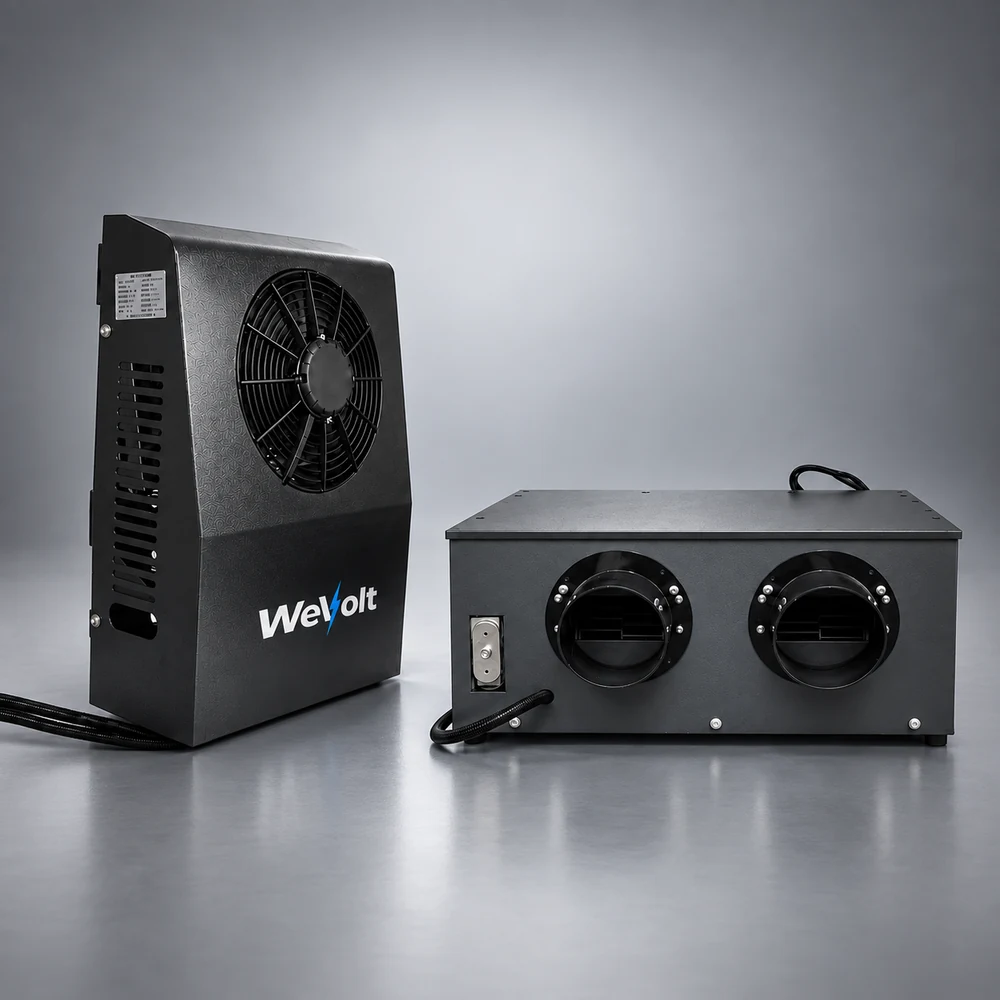
A full setup has three parts: a dedicated 24V auxiliary lithium battery, a 24V DC parking air conditioner (the WeVolt WTAC-24V-10C-5H as the example), and wiring that electrically isolates the auxiliary bank from the starter battery. With the engine off, the air conditioner draws only from the auxiliary bank and never touches the starter battery.
Why 24V? The truck chassis is 24V. At the same power, a 24V system carries half the current of a 12V system (power = voltage × current), so the cable is thinner, runs cooler, and loses less. WeVolt matches this to the WeVolt Apex eAPU platform, with no 12V/24V auto-switch, so the whole electrical side stays consistent. For drivers comparing air conditioning for semi trucks across brands, the 24V foundation is the first thing to confirm.
How the runtime math works
One sentence states it:
Runtime (hours) ≈ usable battery energy (kWh) ÷ average AC input power (kW)
Three variables decide how close the estimate lands:
- Usable battery energy: rated capacity times depth of discharge. LiFePO4 safely releases about 90%, lead-acid only about 50%. Same 100Ah rated, lithium's usable energy is nearly double lead-acid's.
- AC input power: an inverter unit ramps down after the cab cools, so average draw sits below the rated value. Don't treat rated power as a constant across the night.
- Ambient temperature and setpoint gap: hotter outside and a lower setpoint raise the compressor duty cycle, so it draws more. A setpoint of 23–24°C saves far more than 18°C.
This gives the method and the order of magnitude, not an exact figure for your unit. Drop your battery's rated capacity and your AC's rated input into the formula and you estimate your own overnight runtime. Below, a matched, validated system is the example.
The worked example: does 8.04 kWh cover a full night
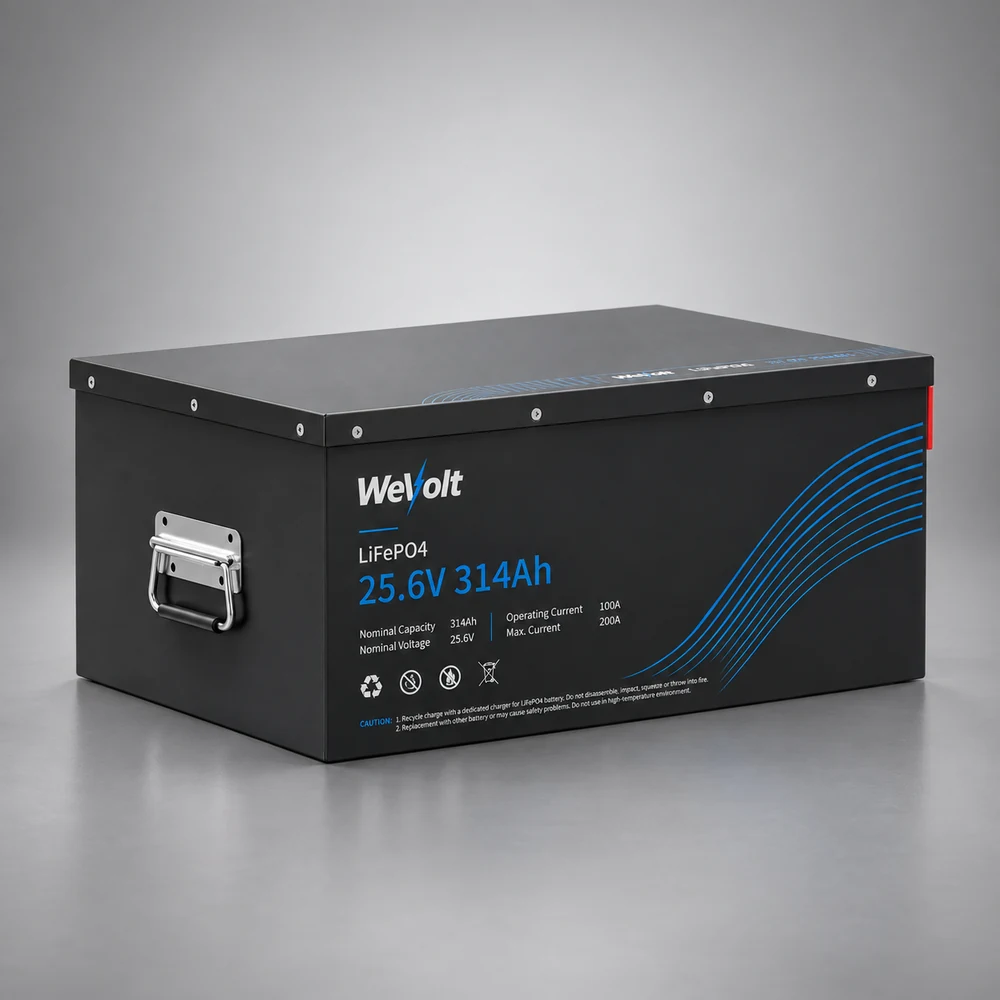
Take the WeVolt Apex eAPU standard parking battery: 8.04 kWh = 25.6V × 314Ah LiFePO4. Usable energy is about 8.04 × 90% ≈ 7.2 kWh.
On the cooling side, the WTAC-24V-10C-5H draws about 900W at rated input. At continuous full load: 7.2 kWh ÷ 0.9 kW ≈ 8 hours; once the inverter ramps down, actual runtime reaches about 9–10 hours. That lines up with the “about 8–10 hours overnight” rating.
Conclusion: for one 10-hour HOS rest, cooling mode covers the whole night with margin, provided you pre-cool while driving, set 23–24°C, and shade the bunk. Do those and the runtime matches the rating.
Runtime in short: 8.04 kWh LiFePO4, about 8–10 hours cooling, enough for one engine-off rest. Your actual numbers depend on your battery and route.
Cooling vs heating: how far the runtime gap is
Cooling and heating are not the same load, and the runtime gap is clear:
Heating uses PTC resistive heat (1600W, about 5,500 BTU on the WTAC-24V-10C-5H). It does not run the compressor, so it draws more, and runtime lands at roughly half the cooling figure. State this plainly so nobody assumes winter also runs a full night on one charge.
We don't overstate extreme cold. On routes that drop dozens of degrees below zero, electric heat drains the battery fast and struggles to raise the temperature. WeVolt backs this with an optional diesel auxiliary heater (a separate 12V device, outside the 24V power loop); we don't claim one air conditioner alone carries the whole winter, nor that a single setup covers the year. Size to the temperature range you actually run.
Protecting the starter battery: low-voltage cutoff plus isolation
The scariest failure of an all-night setup is not a warm bunk but a dead starter battery the next morning. Two design points fix it:
- Low-voltage disconnect (LVD): the WTAC-24V-10C-5H sets an undervoltage cutoff; below 21.5V (reset at 25V) it shuts off automatically, protecting the auxiliary battery from over-discharge. At the system level the auxiliary bank is isolated from the starter battery, so the air conditioner never drains the starter side.
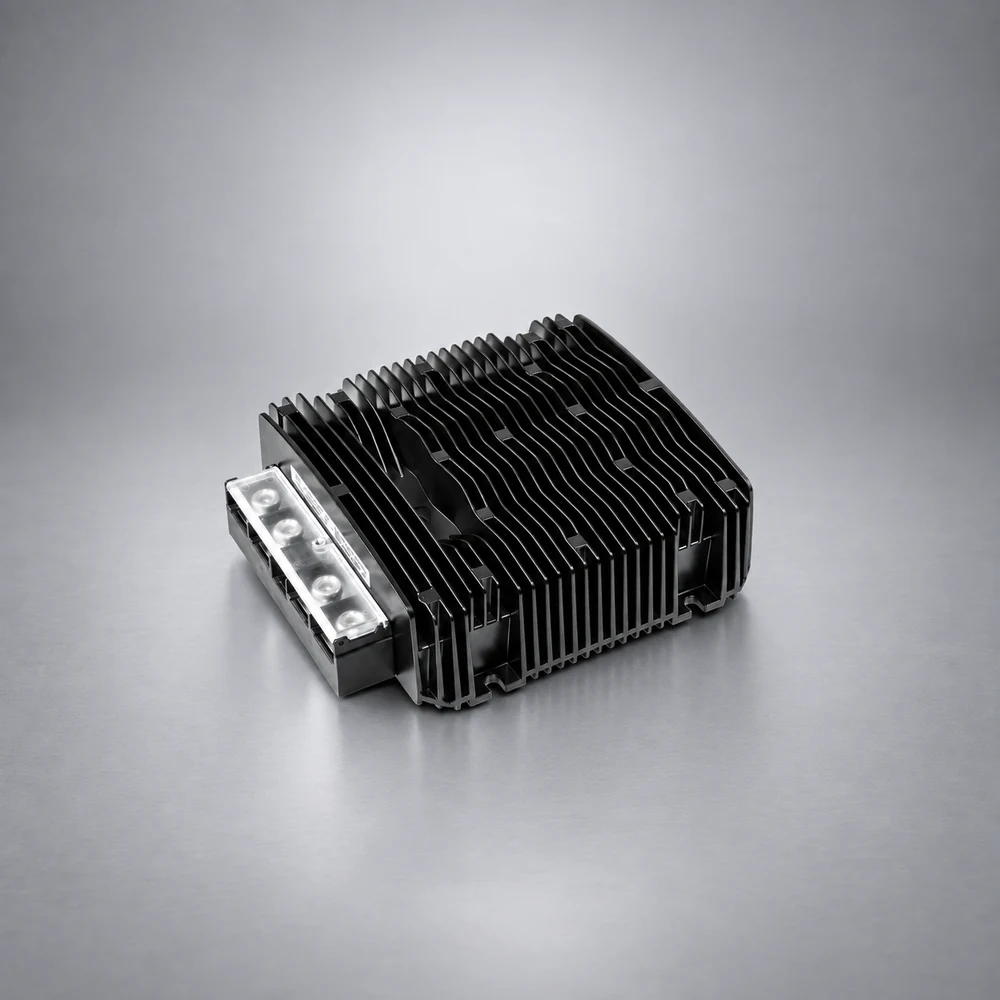
- Reverse-charge backup: the system's bidirectional DC-DC charger (WTDC-12-24V-50A) tops the starter battery in reverse at up to 14.4V / 100A while parked or driving, preventing a no-start the next morning.
Low-voltage cutoff and isolation are the safety floor of an all-night setup, not options. Any design that skips the cutoff and ties straight to the starter battery carries a stranded-vehicle risk over time. A truck parking air conditioner that lacks a stated cutoff is not one to trust overnight.
Charging while driving: fill the battery on the road
The auxiliary battery is not slowly topped by solar; it charges mainly while driving. The bidirectional DC-DC charger pushes forward at up to 29.2V / 50A, charging the 24V auxiliary bank while the engine runs, so by the time you reach the rest stop it is full.
Charging and pre-cooling line up best: in the last hour of driving, run the main truck AC to pull the heat out of the mattress and walls while the alternator fills the auxiliary battery; pull in, shut down, switch to the auxiliary bank, and you start the night at full charge. The whole-night runtime is full from the first hour, with no middle-of-the-night anxiety about the battery.
Six practices to stretch the runtime
- Pre-cool while driving: in the last hour, use the main truck AC to dump the bunk and mattress heat, so the auxiliary bank starts lighter.
- Set 23–24°C: don't force 18°C; a smaller gap lets the inverter ramp down and lowers the duty cycle noticeably.
- Shade the bunk: reflective shades block the sunny side and cut the extra heat load.
- Wash the filter every two weeks: a dirty filter forces the compressor high and shortens runtime; the manual forbids running without a filter.
- Correct cable gauge: pure copper, at least 6 AWG (about 16mm²) within 3m, step up to 4 AWG (about 25mm²) beyond 5m, to avoid voltage drop tripping the low-voltage cutoff.
- Optional roof solar: eases the daily drop in daylight and extends margin, but it is an aid, not a standalone source.
An air conditioner is not a maintenance-free device: the manual calls for the filter out at least every two weeks, washed and refitted; running without a filter is forbidden. Runtime and life both rest on this, and any unit labeled “maintenance-free” is hard to trust on a truck air conditioner that eats dust and vibration year-round.
Buyer checklist: what an all-night setup must include
Turn the points above into a checklist you can tick, so the words “blows cold” don't carry the decision:
- 24V dedicated unit: prefer 24V dedicated, not 12V-plus-converter, not auto-switch.
- Auxiliary lithium: capacity at least the 8.04 kWh tier (LiFePO4, about 90% depth of discharge) to cover overnight.
- Low-voltage cutoff: must protect the starter battery; don't let the AC tie straight to the starter bank.
- Bidirectional DC-DC: charges while driving and reverse-charges the starter battery; both rely on it.
- Correct cable gauge: pure copper, AWG by length, against voltage drop.
- Cooling and heating: if you run in winter, pick a unit with PTC electric heat; for extreme cold add a diesel auxiliary heater.
Take the WeVolt Apex eAPU as a set that meets the list: a 24V dedicated air conditioner WTAC-24V-10C-5H (3000W cooling / about 10,000 BTU, 1600W heating), an 8.04 kWh LiFePO4 parking battery, a WTDC-12-24V-50A bidirectional DC-DC (forward up to 29.2V / 50A, reverse up to 14.4V / 100A), and a 21.5V low-voltage cutoff. It is one matched, validated part of the WeVolt Apex eAPU system, not a standalone piecemeal build. Full specs sit on the air conditioner product page, the parking battery page, and the bidirectional DC-DC charger page.
The checklist is a judgment frame, not a recommendation for one set. Check the six points against the set you are eyeing; wherever a figure is missing, ask the seller for it in writing; don't buy on the words “all-night no-idle” alone.
Summary and next steps
All-night no-idle comes down to four things matched: a 24V auxiliary lithium battery, a 24V dedicated unit, low-voltage isolation, and DC-DC charging. At 8.04 kWh paired with 900W cooling, it covers one 10-hour HOS rest with margin; heating runtime is about half the cooling figure, and extreme cold still needs a diesel auxiliary heater. Runtime is not guessed; it is the battery capacity and AC power run through a formula.
Three things to keep: first, pick LiFePO4 with capacity to cover overnight, and don't count lead-acid's 50% usable depth as full; second, low-voltage cutoff and isolation are the floor, and what they protect is a start the next morning; third, the bidirectional DC-DC charges on the road, so you arrive at a full battery. To go further on air conditioning for semi trucks:
Full AC specs: WTAC-24V-10C-5H truck parking air conditionerThe 24V parking battery the runtime rests onBidirectional DC-DC charging on the road12V vs 24V vs 48V: how to pick the voltageWhole system: WeVolt Apex eAPU planQuote: [email protected]
References
- WeVolt air conditioner marketing brief: 24V, 3000W cooling (about 10,000 BTU) / 1600W heating (about 5,500 BTU), below 30 dB, rated about 8–10 hours overnight, 2-year warranty / 5+ year design life, 52°C, R-134a, split under-bunk.
- WTAC-24V-10C-5H installation and service manual: full specifications (3000W cooling / 1600W heating, about 900W / 38A, 450 m³/h, EER 2.85, R-134a), voltage protection thresholds (undervoltage 21.5V / overvoltage 32V / overload 55±3A), maintenance requirement (filter every two weeks).
- WeVolt Apex eAPU system technical overview: HVAC WTAC-24V-10C-5H / 24V DC, 10,000 BTU cooling & 5,500 BTU PTC heating; bidirectional DC-DC forward up to 29.2V / 50A, reverse up to 14.4V / 100A; battery 25.6V / 314Ah LiFePO4.
- WeVolt C-Series component catalog: WTAC-24V-10C-5H full spec and matched components.
- WeVolt 24V 314Ah truck battery material: 8.04 kWh LiFePO4 parking battery highlights.
- Public competitor material (runtime formulas, cable gauge and low-voltage protection structure, ROI framing) is used only as industry-method reference; this article does not cite specific competitor brand or model figures.
This article is a runtime and configuration method description. Exact refrigerant charge, cooling input power, and installation fit follow the formal spec sheet or our confirmation. Legal entity and registered address follow the official published page.