

At a rest stop, some drivers bolt an RV rooftop unit or a residential 12V air conditioner into the truck bunk to save money. A few months in, it stops cooling, hums louder, or the starter battery is dead the next morning. This article does not argue whether a truck air conditioning setup blows cold; it lays out what breaks first, and why, when a unit built for a still environment lands in a truck that vibrates all day and bakes past fifty degrees by the engine bay, and what a truck-built unit does differently.
Intro: bolt it in cheap, pay for it months later
After the truck shuts down, someone still lives in the cab. To stay cool in summer, some drivers move an RV rooftop unit or a residential 12V air conditioner into the truck. The reasoning is direct: cheap, already on hand, cools right now.
But those machines are built for a still, mild environment. A truck vibrates all day and bakes past fifty degrees by the engine bay; the duty is nothing like home. A few months in, the common endings are no cooling, rising noise, or a dead starter battery the next morning. This article breaks down what breaks first and why, so you can judge whether a unit belongs in your truck instead of just reading the price tag.
The short answer: early failure is duty mismatch, not bad luck
A truck air conditioner built for the job does not fail early by bad luck; it fails early by duty mismatch. An RV or residential unit runs fine in an RV or a house, then fails early in a truck because of three pressures a home environment never has: constant vibration, engine-bay heat past fifty degrees, and the electrical gap between the truck's 24V DC and the 120V AC most RV units expect.
Below are the four failure mechanisms: vibration, heat, electrical, and size. Each points at a concrete failure, not a vague “not durable.”
What vibration breaks first
On the road, vibration is constant. An RV rooftop unit runs hard copper tubing with brazed joints; in a parked RV that is a strength, sealed tight, no refrigerant creep. Drop that same unit into a vibrating truck and those brazed joints and the sheet metal fatigue and crack, and the refrigerant leaks slowly.
Automotive AC, by contrast, uses rubber hoses and flexible joints precisely to absorb shock; an RV unit has no such buffer, and its anti-vibration structure is not built to truck grade. The consequence is direct: cooling fades year by year until it stops. A truck-built unit answers with high-strength sheet metal and an anti-vibration structure meant for long-haul road shock, not an RV berth at rest. That is the first line where “cracks or not” gets decided.
This is about mechanism, not a fabricated failure-rate number for RV units. The basis is simple: an RV unit's tubing and anti-vibration design target a static environment, while a truck is dynamic, so the mismatch raises early-failure risk. It does not mean a given unit is certain to fail in months.
What heat breaks first
In summer, the sunny side of a rest stop and the area near the engine bay can pass fifty degrees. Most RV units state no high-temperature operating ceiling; run long there and start and run capacitors trip on overheat, compressor lubrication thins, and housing plastic goes brittle.
A truck-built unit is rated to an operating environment up to 52°C, which is what the real duty calls for. For drivers on southern or desert routes, this matters more than a cooling number on paper: a unit with no stated high-temp ceiling, running through hot afternoons, carries visibly higher failure risk.
What electrical mismatch breaks first
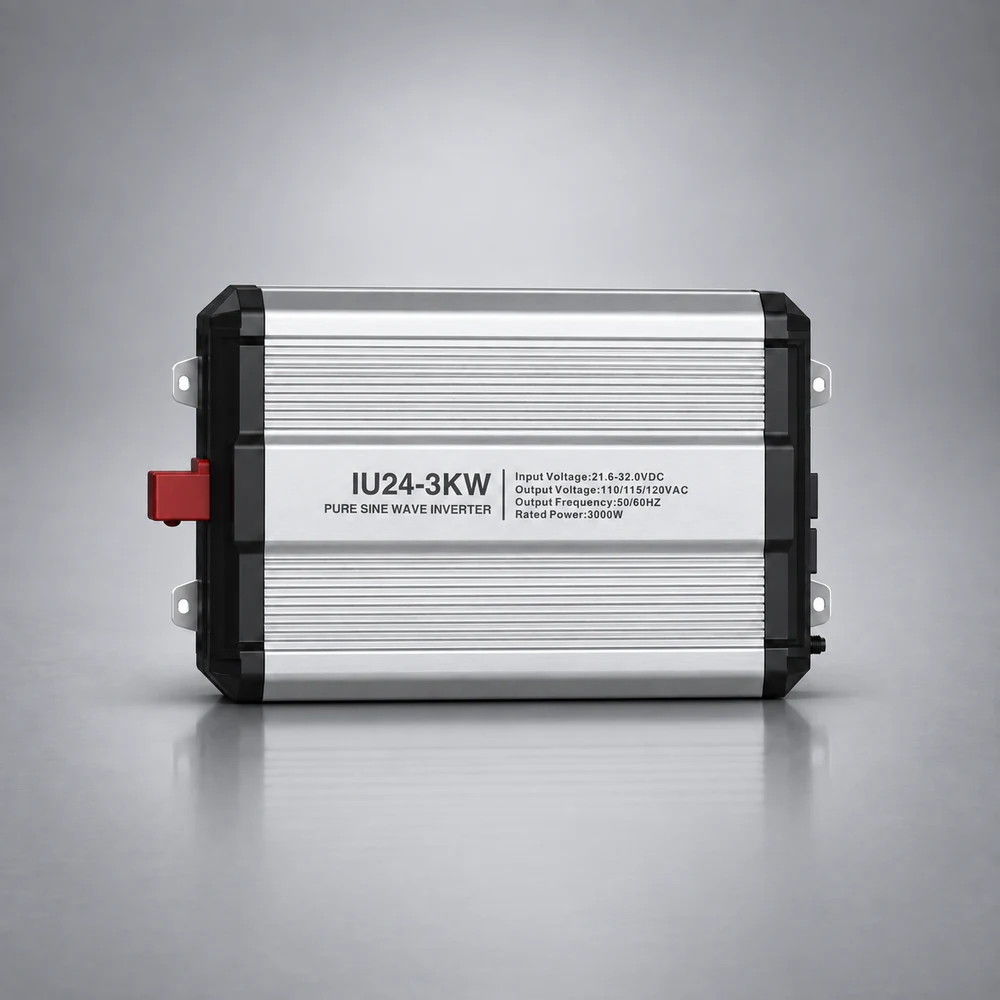
Most RV units are designed for 120V AC; a truck is 24V DC. To get an RV unit into a truck you run it through an inverter or converter, and that conversion is where trouble starts: line loss, voltage drop, and short-cycling burn the start capacitor and control board.
If the unit auto-switches 12V/24V, at the same power a 12V system draws twice the current of a 24V system (power = voltage × current), so the cable must be thicker, hotter, and lossier. That doubled current is itself a breeding ground for electrical failure. A 24V dedicated truck unit shares the truck's whole voltage platform, with no conversion and half the current, so the power side stays simpler and steadier. That is also why the whole eAPU is matched as a 24V set; the air conditioner is just one part of it.
What size mismatch breaks first
RV units are sized for a large RV shell, with cooling to spare. Drop one into a small truck bunk and it hits temperature fast, then the compressor short-cycles, which wears it faster, controls humidity poorly, and draws more. An oversized unit in a small space is a silent killer of compressor life. A truck-built unit is sized to the bunk volume, avoiding that over-spec. When choosing, look at cabin volume, not just “more power cools faster.”
Sealed systems can't be field-serviced: a leak means replace
RV rooftop units and truck units are mostly sealed refrigeration systems with no service ports from the factory. Once the refrigerant leaks, you cannot recharge it in the field; you replace the whole unit. This is not a defect of one brand, it is the common structure of compact air conditioners.
We don't overstate serviceability. The WeVolt WTAC-24V-10C-5H is also a sealed system; we do not claim it can be recharged in the field. Its edge over an RV unit is not “repairable” but “longer by design and backed by a real warranty”: 2-year warranty, design life over 5 years, which lowers replacement frequency, not “breaks and gets fixed on site.” The only user-side action that extends life is maintenance (filter every two weeks), and it is not a maintenance-free device.
How a truck-built unit avoids breaking (the checklist it meets)
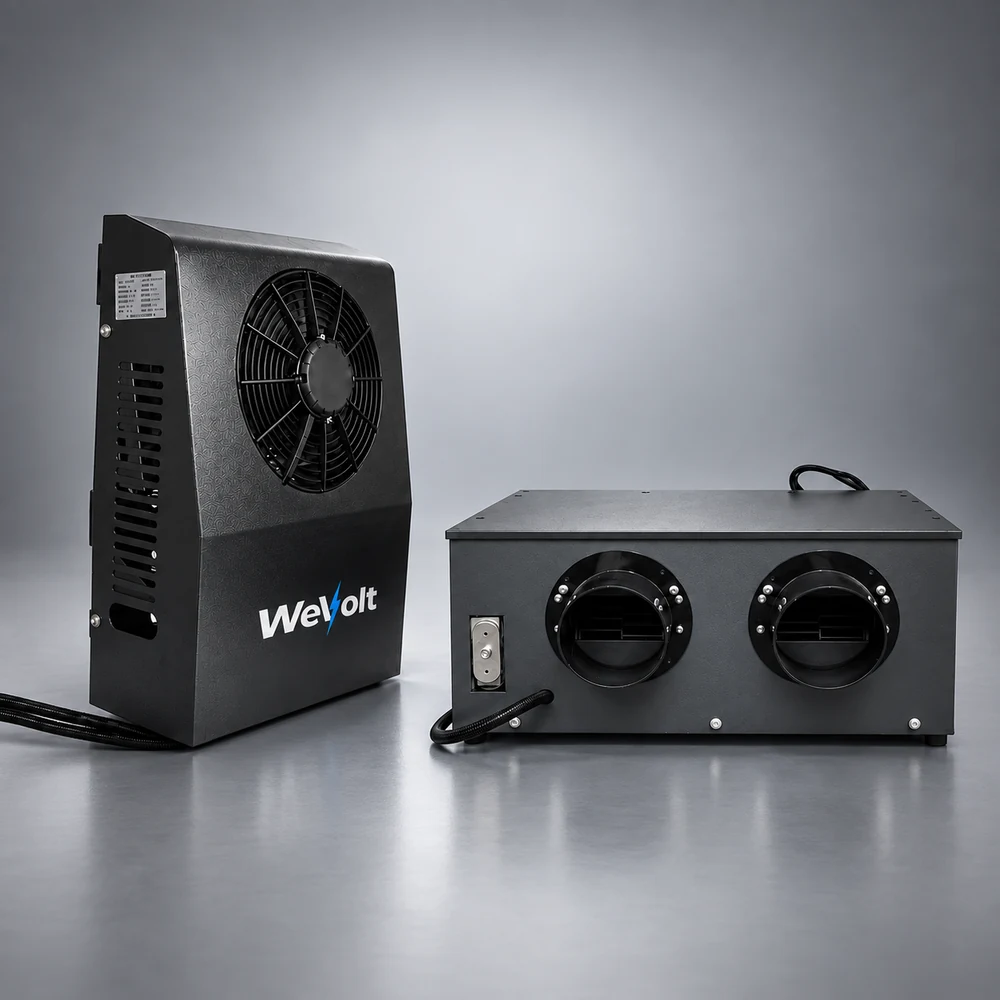
Flip the four mechanisms and you get what a truck-built unit should meet. Take the WeVolt WTAC-24V-10C-5H as the example:
- 24V dedicated: no conversion, shares the truck platform, half the current.
- Truck-grade anti-vibration: high-strength sheet metal with anti-vibration structure for long-haul road shock, not an RV berth.
- Rated to 52°C: operating environment to 52°C, matching engine-bay heat.
- Split under-bunk: indoor unit under the bed, no roof hole, less vibration transfer, quieter at night.
- Cooling and heating: PTC electric heat 1600W (about 5,500 BTU), year-round, with an optional diesel auxiliary heater for extreme cold.
- Real warranty and life: 2-year warranty, design life over 5 years, plus a stated maintenance requirement.
It is one matched, validated part of the WeVolt Apex eAPU system, not a standalone piece. Full specs sit on the truck parking air conditioner product page; runtime math on the parking battery page.
Buyer checklist: six things to verify
Turn the points above into a checklist you can tick, so the words “blows cold” and a low price don't carry the decision:
- Don't bolt an RV / residential unit into a truck: duty mismatch, high early-failure risk.
- Confirm 24V dedicated: not 120V AC via inverter, not 12V auto-switch.
- Confirm high-temp ceiling: for hot regions, the 50°C-plus tier.
- Confirm truck-grade anti-vibration: high-strength sheet metal / anti-vibration structure, not a residential shell.
- Confirm low-voltage cutoff: protects the starter battery; don't tie the AC straight to the starter bank.
- Confirm warranty and life plus maintenance: warranty years, design life, and the filter interval.
The checklist is a judgment frame, not a recommendation for one unit. Check the six points; wherever a figure is missing, ask the seller in writing; don't buy on the words “truck-built” alone.
Summary and next steps
An RV unit fails early in a truck because of four duty mismatches: vibration fatigues copper and sheet metal and leaks refrigerant; heat ages capacitors and plastic; the electrical gap burns capacitors and control boards; oversizing makes the compressor short-cycle. A truck air conditioner answers with 24V dedicated, anti-vibration structure, a 52°C rating, split under-bunk, and a real warranty.
Before you buy, think about the duty you actually run: hot regions check the high-temp ceiling, rough roads check anti-vibration, power checks 24V dedicated. For drivers comparing air conditioning for semi trucks across brands, the same duty check applies to the sleeper-cab use case. To go further:
Why 24V truck-built outlasts RV: WTAC-24V-10C-5HFull AC specs: truck parking air conditioner component pageThe 24V parking battery the runtime rests on12V vs 24V vs 48V: how to pick the voltageWhole system: WeVolt Apex eAPU planQuote: [email protected]
References
- WeVolt air conditioner marketing brief: 24V, 3000W cooling (about 10,000 BTU) / 1600W heating (about 5,500 BTU), below 30 dB, rated about 8–10 hours overnight, 2-year warranty / 5+ year design life, 52°C, R-134a, split under-bunk.
- WTAC-24V-10C-5H installation and service manual: full specifications (3000W cooling / 1600W heating, about 900W / 38A, 450 m³/h, EER 2.85, R-134a), voltage protection thresholds (undervoltage 21.5V / overvoltage 32V / overload 55±3A), maintenance requirement (filter every two weeks).
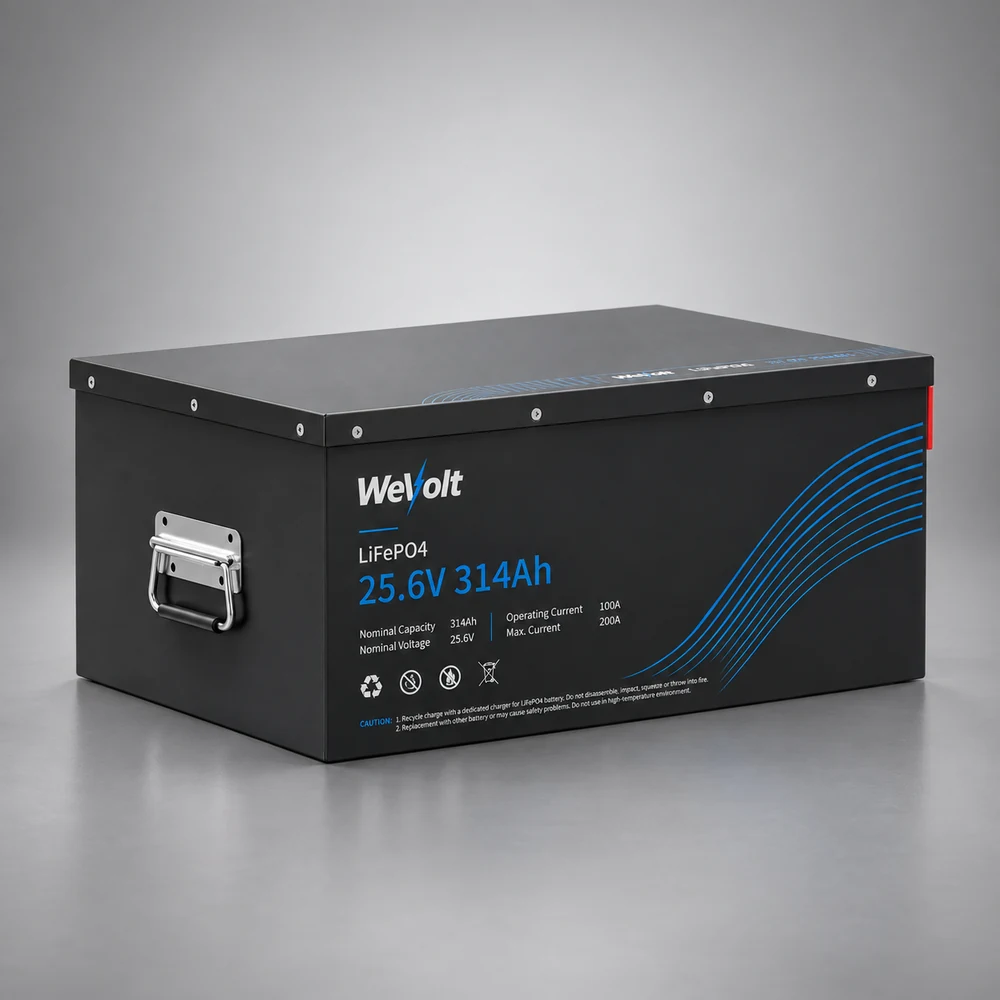
- WeVolt Apex eAPU system technical overview: HVAC WTAC-24V-10C-5H / 24V DC, 10,000 BTU cooling & 5,500 BTU PTC heating; battery 25.6V / 314Ah LiFePO4.
- WeVolt C-Series component catalog: WTAC-24V-10C-5H full spec and matched components.
- Public competitor material (RV-unit sealed-system structure, automotive rubber-hose shock leakage vs RV hard-copper brazing, RV-unit 120V AC supply traits, oversizing causing short-cycling) is used only as industry-method reference; this article does not cite specific competitor brand or model figures.
This article is a failure-mechanism and buying-method description. Exact refrigerant charge, cooling input power, and installation fit follow the formal spec sheet or our confirmation. Legal entity and registered address follow the official published page.
Overnight cooling on a 24V system, measured