
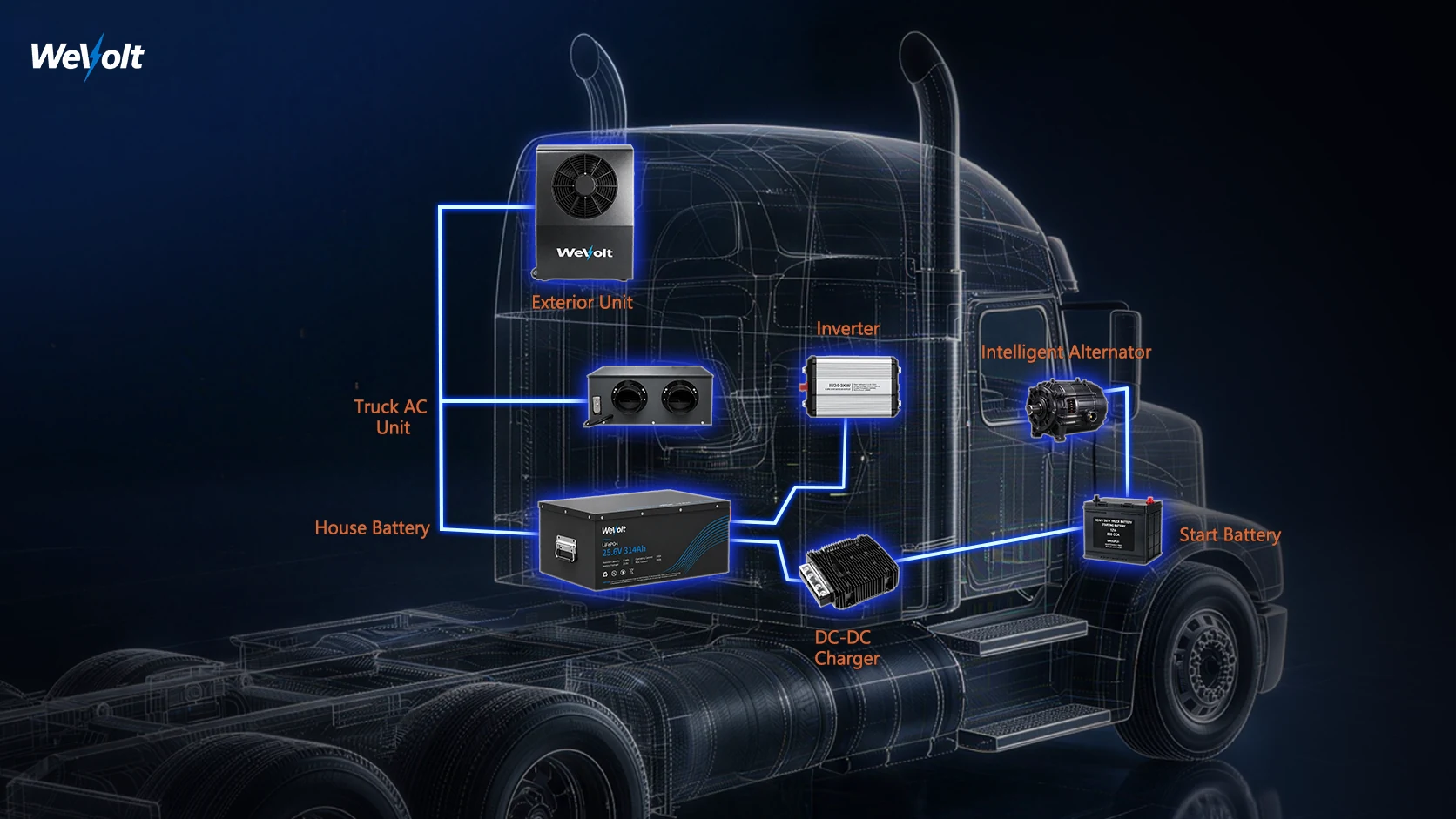
Once a truck parking power system has stopped working, the questions that follow concern which layer the fault falls in, which checks can be carried out on site, how the component to be replaced is identified, and what the local technician and the manufacturer respectively undertake. This article deals with all-electric parking systems that have no on-board diesel generator: it defines the system configuration and the four categories of malfunction, then sets out in order the isolation of power sources, the documentation of on-site information, the sequence for locating a fault by symptom, the house battery and charging circuit, the protection thresholds and fault codes of the parking air conditioner, the status indications of the inverter and the bidirectional DC-DC charger, the separate troubleshooting of a diesel heater where one is fitted, the identification and verification of replacement parts, the two distinct paths of local repair collaboration and warranty claims, and the handling of downtime together with preventive maintenance. Rated conditions, wiring methods and operating requirements are governed by the product manuals and by the consistent information supplied by the manufacturer; values not stated in the documentation provided with the unit are not inferred here.
1. System configuration and four categories of malfunction
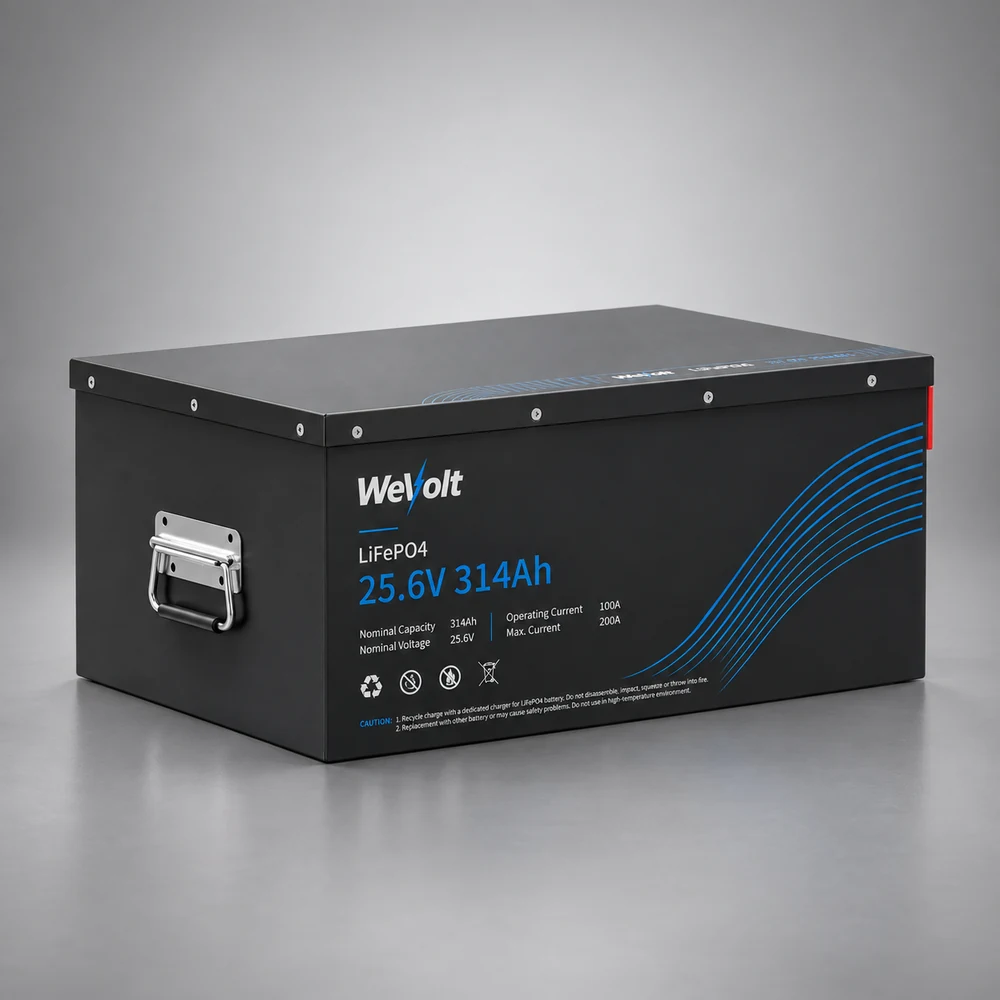
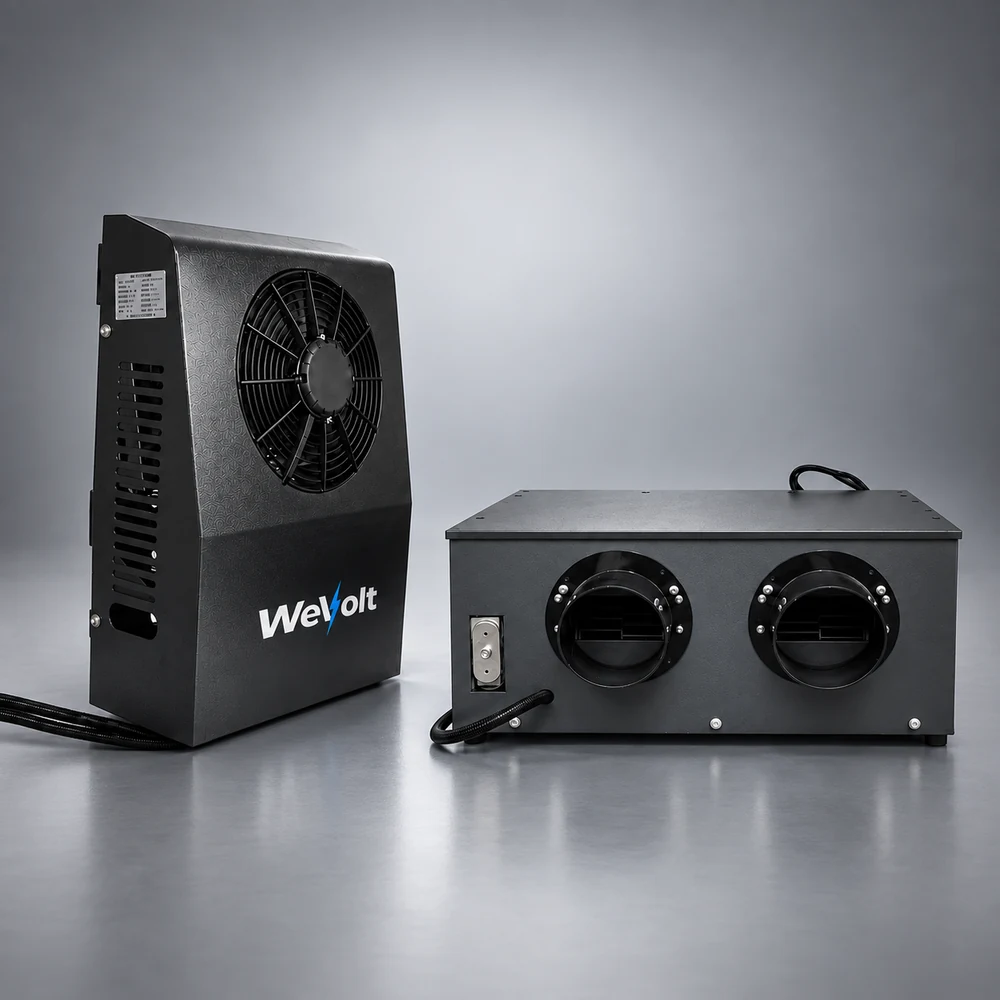
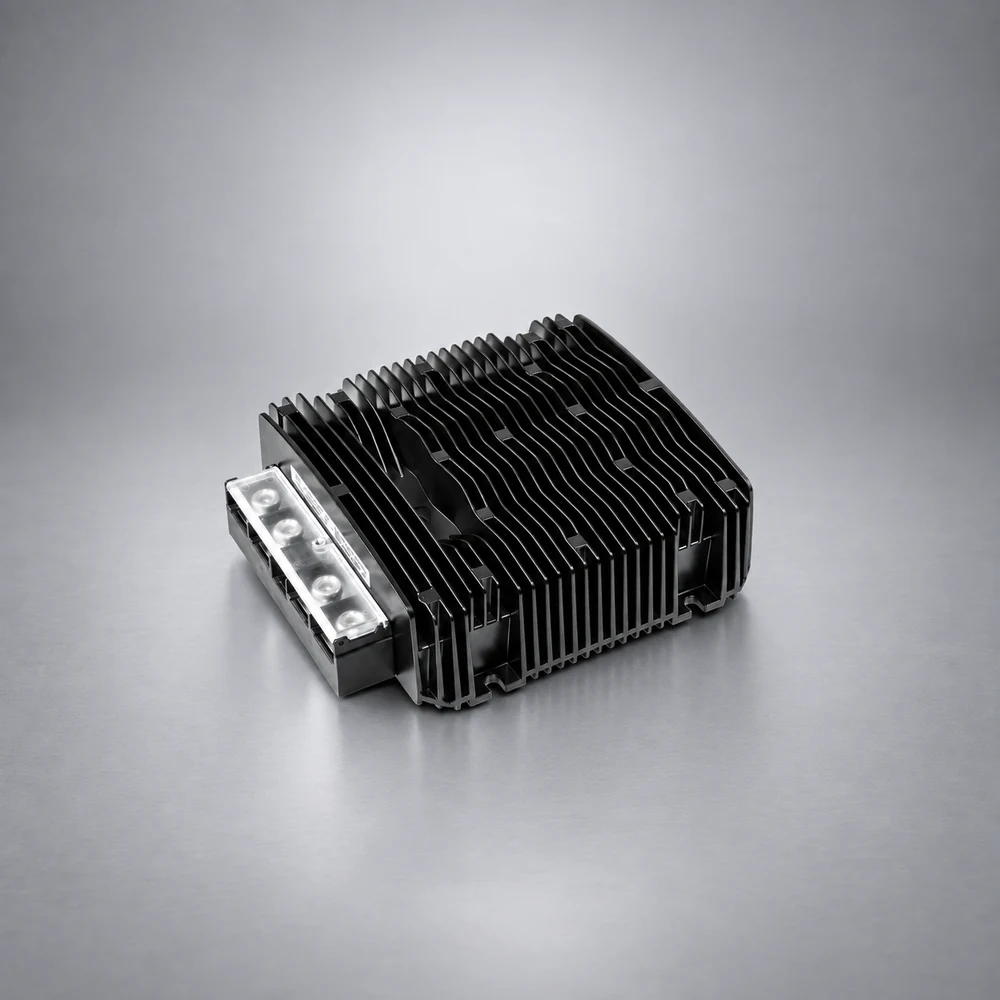
An all-electric parking system does not rely on an on-board diesel generator; cooling, heating and hotel loads while parked are supplied by the house battery, which is replenished by the vehicle charging system while driving. The WeVolt Apex eAPU comprises a 24V house battery (25.6V / 314Ah / 8.04kWh, with a 200A JK BMS), a split parking air conditioner WTAC-24V-10C-5H, a bidirectional DC-DC charger WTDC-12-24V-50A, and, according to configuration, a 3,000W pure sine wave inverter IU24-3KW and a 5kW diesel heater WTDH-12V-5KW. The components occupy different positions in the power chain, and the resulting symptoms accordingly fall on different layers.
Diesel APUs equipped with a small diesel engine, generator, independent coolant circuit and exhaust system constitute a separate category of equipment. Troubleshooting procedures for their engine, glow plugs, oil pressure, fuel filter, drive belts and coolant differ from those of all-electric systems and are outside the scope of this article. The two categories are compared as complete systems in a separate guide.
Four observable categories of malfunction
Converting the statement that the system has failed into observations that can be checked is the precondition for every subsequent judgement. Abnormal conditions in an all-electric parking system fall broadly into four categories.
A single sign may span several components. Insufficient cooling, for example, may arise from a low house battery voltage, a blocked filter or poor condenser heat dissipation alike. Eliminating layers in order is more reliable than concluding immediately that a particular component has failed, and it also makes the condition easier to describe to a technician or to the manufacturer.
The same product category may refer to different configurations in the catalogues of different manufacturers. Before beginning troubleshooting, confirm the configuration actually installed against the manuals provided with the unit; whether the optional components have been fitted determines directly whether certain checks apply.
An optional diesel heater is not driven from the 24V house battery power loop, and its faults are to be troubleshot separately from those of the electric drive system. Applying the supply conditions, fault codes or protection ratings of one system to the other will produce an incorrect conclusion.
2. The first step on site: isolating power sources and documenting information
The first step after a malfunction occurs is not to repeatedly power the equipment on to test it, but to isolate the power supply according to the manual provided with the unit and to document the on-site information. These two actions determine whether subsequent troubleshooting can be conducted safely and whether there is a basis for claims and part identification.
Isolating power sources and handling lithium-ion batteries
The all-electric system includes high-current DC circuits, lithium-ion batteries, the vehicle charging system and permanently installed electrical equipment. The service notes on the system configuration diagram state it clearly: the main switch set to the off position does not isolate the charger's power supply, and all power sources must be isolated in accordance with the manual before inspections or maintenance. Perform only inspections that can be completed safely; operations requiring specialized skills should be performed by a qualified technician.
A lithium-ion battery must not be opened, nor returned before return instructions have been obtained. Battery transport is subject to dangerous goods rules; a battery that is damaged, swollen or suspected of an internal fault should be reported to the service provider first and then handled in accordance with its packing and shipping instructions. The public guidance issued by the Federal Aviation Administration on the transport of lithium batteries sets out the basic restrictions that apply to such batteries in transit.
Information to be documented
The following information is both the input for on-site diagnosis and the material required for identifying a replacement part and submitting a warranty claim. Recording should be completed, as far as possible, before power is disconnected and before any disassembly.
Where inspection or return is required, agreement should first be reached with the service provider, after which the return authorization, service address and shipping instructions supplied by it should be followed; work expected to be borne by the manufacturer should likewise be confirmed before it is carried out. Arranging work independently and reporting it afterwards readily gives rise to disputes over cost allocation.
Repeatedly powering the equipment on to test it may enlarge the scope of the fault and may also erase a fault code that has not yet been recorded. Once power has been isolated and the information documented, diagnosis continues in the layered sequence that follows.
3. Locating the fault by symptom: power supply and connections first
Truck APU troubleshooting proceeds through three layers: power supply and connections first, then control and settings, and finally the component itself. Conditions common to several components are checked before moving to the checks specific to one of them. The causes of a fault vary with the vehicle, the operating conditions and the installation, and it is not reliable to infer the failure of a particular component from a fixed proportion.
Six common conditions to check first
These six conditions belong to different components yet can produce similar signs. Once each has been checked on site and the symptom remains, the module-specific checks that follow apply. Faults caused by incorrect installation or wiring are addressed separately in the warranty terms, the precise scope being governed by the official warranty policy page and the warranty documents supplied with the unit.
Dividing line between owner checks and authorised work: visual inspection, filter cleaning, panel recording and verification of settings can be completed on site. Live measurement, work on the refrigerant circuit, opening the battery, internal circuitry and control parameter adjustments should be performed by a qualified technician with the relevant electrical, mechanical and refrigeration competences.
The established structure of APU troubleshooting in the industry generally follows four stages: symptom, possible causes, quick checks, and when to involve a professional. Publicly available guides of this kind illustrate the sequence. The specific causes and values given for diesel-powered units do not apply to all-electric systems, and an "APU won't start" condition in one category of equipment is not diagnosed in the same way as in the other.
4. The house battery, the BMS and the charging circuit
The house battery is the sole source of power for the all-electric system while parked, and most instances of no output at all or short operating time lead back to this layer. The published parameters of the battery used in the WeVolt Apex eAPU are set out below; in parts catalogues the same storage module may also be described as a truck apu battery, and the model designation on the nameplate remains the reliable identifier.
Checks to be carried out on site
Natural capacity loss with age and cycling is not a manufacturing defect. Where battery condition requires assessment, the service provider may reach a conclusion by reference to charge settings, BMS records and a controlled capacity test; whether the condition falls within coverage is determined under the official warranty policy and the warranty documents supplied with the unit. Normal ageing and a manufacturing defect are two different categories of problem.
Battery management system records, charge settings and protection thresholds should be read and assessed by the service provider according to its procedures. Adjusting them independently may change the protection conditions of the system and may also affect the subsequent determination of the cause of a fault.
The voltage platform of the house battery, the voltage platform of the starter battery and the output capacity of the vehicle alternator together determine the operating conditions of the charging circuit, and all three should be checked against the vehicle technical documentation. Differences between trucks in these three items are encountered more often than differences in the battery itself when charging abnormalities arise.
The 8.04kWh house battery: ratings, BMS protections and cold-weather self-heating5. The parking air conditioner: thresholds, fault codes and owner checks
The WTAC-24V-10C-5H parking air conditioner service manual groups the problems commonly encountered on site into three categories and gives voltage and current protection thresholds together with a complete table of fault codes. These values apply to that model alone, and both reading and interpretation are governed by the manual supplied with the unit.
Protection thresholds
An undervoltage or overvoltage protection action indicates that supply conditions have moved outside the permitted range; it does not by itself establish that the battery or the compressor has failed. Voltage drop, loads engaged simultaneously, voltage fluctuation during charging and the specification of the dedicated supply line can all bring the controller into a protection state.
Reading the fault codes
The service manual gives 42 fault codes. The table below sets out the meaning of a group encountered comparatively often and the direction of the corresponding checks; the complete list is governed by the manual supplied with the unit.
Fault code tables are not interchangeable. Parking air conditioners of different makes and models use their own code systems, and the same code may point to entirely different components. Manufacturer repair manuals commonly adopt a table structure of displayed code, description, cause, remedy and further measures, but the specific meanings must not be transferred to another product.
Dividing line between owner checks and specialist work
Where the electric heating ratings belong: the electric heating current of approximately 66.6A and the corresponding 100A factory protection rating shown on the system configuration diagram belong to the PTC electric heating branch of the parking air conditioner, on the 24V side. Neither is a current or fuse rating of the diesel heater, nor a fault criterion for the air conditioner as a whole or for the inverter, and the two sets of figures should not be cited in place of one another.
Where a component has to be ordered, air conditioning parts for trucks are identified by model and serial number rather than by appearance; suppliers of air conditioner parts for trucks and of truck A/C parts use the same designation, and the same applies to a semi truck air conditioner supplied as a split system. Cleaning, routine refrigeration servicing and the replacement of worn consumables are addressed separately in the warranty terms, as are faults arising from maintenance that has been omitted.
6. The inverter and the bidirectional DC-DC charger
The optional IU24-3KW pure sine wave inverter and the bidirectional DC-DC charger WTDC-12-24V-50A each provide status indications and protective functions. Information available on site comes principally from panel indicators, equipment parameter readings and the check sequence given in the quick start guide. A truck inverter of this class is not diagnosed by the same procedure as the charging converter.
The inverter
Reverse connection is not recoverable. This inverter has no reverse polarity protection. DC-side polarity, terminal markings and conductor order should be verified item by item against the documentation supplied before power is applied; after any change to the wiring, polarity should again be confirmed before the unit is energised.
Power-on checks for the bidirectional DC-DC charger
The first power-on checks and the four-row quick troubleshooting table given in the quick start guide provide a sequence for charging abnormalities. That document is a quick start guide rather than a complete specification sheet or installation manual.
The cable gauges, Class T fuses, main switch and busbar listed in the system-level installation accessory kit belong to the accessory scope of the complete WeVolt Apex eAPU, and the official parts list states that accessories supplied with individual products are not repeated in it. These values must not be transferred to the replacement specification of a single component; auxiliary power unit parts for one module are identified from that module's own documentation. Conductor cross-section, fuse ratings and wiring methods are governed by the manual supplied with the component and by the vehicle technical documentation.
Bidirectional DC-DC charger: forward and reverse charging, control ports and protectionIU24-3KW inverter: protections, Bluetooth monitoring and the no-reverse-polarity rule7. The diesel heater (if fitted): troubleshooting separately
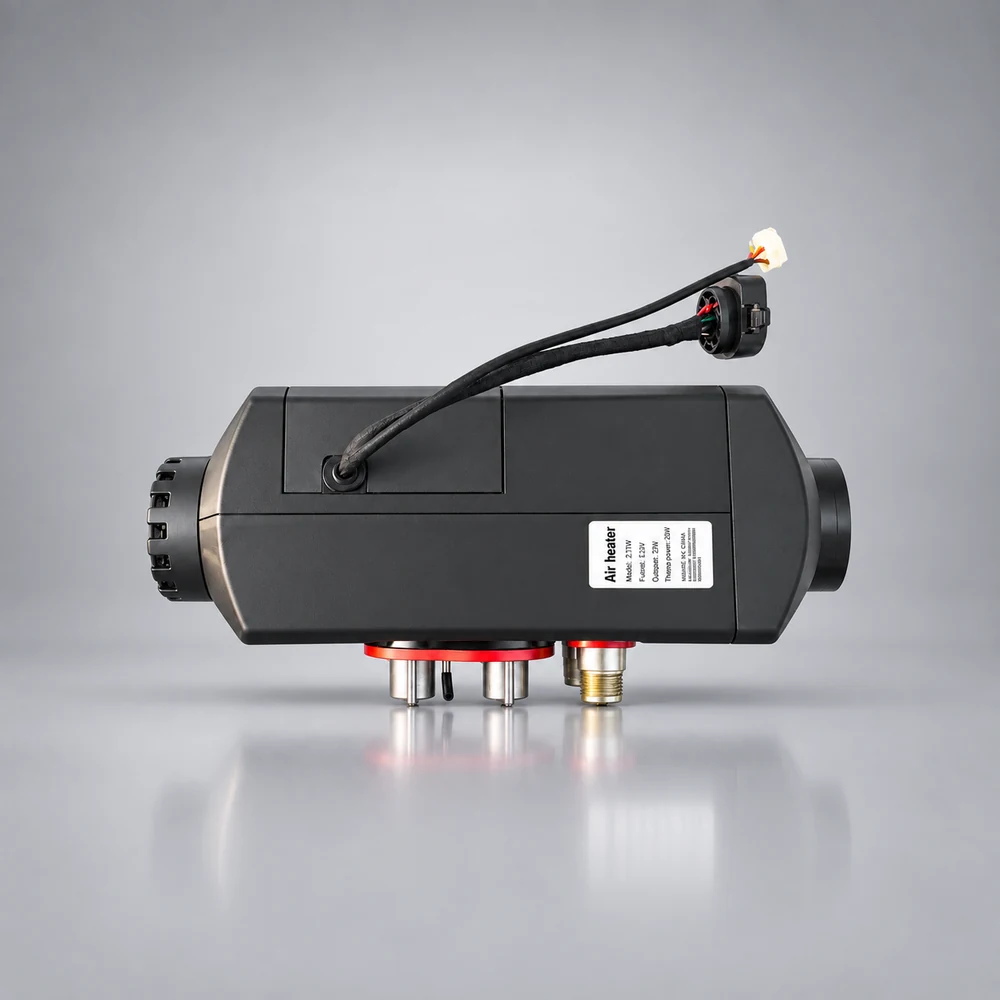
An optional 5kW diesel heater is a combustion heating appliance independent of the 24V house battery power loop, and its supply is taken from the vehicle low-voltage system. Findings from the house battery, inverter and air conditioner side therefore cannot be applied to the heater, and a heater fault does not alter the assessment of the electric drive system. Whether the unit is described as a cab diesel heater, a truck diesel heater or a diesel truck heater in a catalogue, the checks below apply to its own circuits.
Different versions with varying rated voltages of the same product category may coexist on the market, and heavy-duty trucks may also use different low-voltage electrical architectures. Supply conditions, take-off points and protection arrangements should be checked against the manual supplied with the selected model and the vehicle technical documentation rather than inferred from the category name.
Two sets of ratings must not be used interchangeably. The electric heating current of approximately 66.6A and the 100A factory protection rating on the system configuration diagram belong to the PTC electric heating branch of the parking air conditioner; they are not the current, fuse or supply ratings of the diesel heater. The fuel circuit, combustion intake and exhaust, low-voltage supply and, where the model provides the function, the coolant circuit belong to the installation stage.
The manner in which a combustion appliance may be used while occupants are resting in the cab is governed by the operating instructions supplied with the unit and by local safety regulations, including the required configuration and inspection of the intake, exhaust and carbon monoxide protection.
How a diesel parking heater works, and the four circuits it needs installed8. Identifying, verifying and sourcing replacement parts
Establishing which component is to be replaced takes priority over finding a purchasing channel. The all-electric system consists of several main components that can be assessed and replaced individually, and the identification process begins at the component nameplate and ends with four checks before installation.
Scope of the two types of parts list
The system uses commercially available components. Replacement parts and compatible alternatives can be purchased through parts stores and specialist suppliers in the United States, including truck, RV and electrical suppliers; the parts list and product manuals can also be handed to a qualified local technician for assessment and replacement module by module. The model and serial number are the principal means by which a supplier locates a part number, and different versions of the same model may use different components. Catalogues may group the same items under headings such as auxiliary power unit parts, apu parts, truck A/C parts or air conditioner parts for trucks; the designation on the nameplate remains the reliable identifier.
Stock availability and lead times for replacement parts vary by supplier and location. The 3–7 business days quoted for US warehouse shipping and the 8–12 weeks quoted for factory-direct shipping on the site are delivery figures for complete systems and do not represent the arrival time of a replacement part; nor is the component-level list a publicly downloadable document, since it is provided after a fitment review.
Specific part numbers, unit prices and stock locations are not given here. Where any one of the electrical ratings, function, connections or physical fit of a replacement part cannot be confirmed, written confirmation should be obtained from the manufacturer or supplier before installation.
Send your model, serial number and a photo of the label for a parts identification check9. Local repair collaboration and warranty claims: two distinct paths
The concern that nobody nearby can carry out a repair usually contains two separate questions: whether a qualified local technician can be found to perform the work, and whether the fault falls within the manufacturer's coverage. The two do not substitute for one another and are handled separately, whether the matter is described as truck APU repair, auxiliary power unit repair or auxiliary power unit service.
Local technician collaboration
The parts list and product manuals can be handed to a qualified local technician, and the main components of the system can be assessed and replaced individually. The site also publishes arrangements for the installation stage: a local truck repair shop, truck air conditioning specialist, APU installer or fleet upfitter may be introduced to the manufacturer by the owner, following which the manufacturer reviews the installation scope and whether the shop has the capabilities required; the shop need not become a dealer, nor purchase or hold inventory; wiring diagrams, product manuals and technical guidance can be supplied. Installation still requires qualified personnel with electrical, mechanical and HVAC competences, and the work involved varies by truck.
An installation partnership is not a repair network. These arrangements concern installation collaboration; they do not constitute a repair network covering all regions, do not guarantee that any given local shop can service the WeVolt Apex eAPU, and do not promise local parts inventory or response times. Published pages describing manufacturer-operated service networks with multiple locations illustrate a different after-sales model, and the two types of arrangement are not equivalent. The same distinction applies to APU service offered by independent workshops.
Three steps in a warranty claim
A claim reported within the coverage period does not lose eligibility merely because its assessment or repair is completed after that period ends. The coverage periods and covered components of the individual products are governed by the official warranty policy and the warranty documents supplied with the unit; where general marketing content conflicts with the technical documentation supplied with a product, the latter controls.
Remedies and cost boundaries
Self-installation and independent servicing: self-installation or third-party repair does not by itself remove coverage; faults caused by incorrect installation or wiring, incompatible third-party equipment or use beyond the rated conditions are excluded. These two halves are to be read separately.
Returns are not the same as warranty coverage
Products that have been permanently installed, electrically connected, operated, modified, or drilled or cut for installation are generally not eligible for return by reason of a change of mind, compatibility concerns or performance expectations; where a manufacturing defect or technical issue exists, the matter is handled under the warranty policy. The official returns policy specifies a 15-day window, requires contact and an approved return authorization before shipment, applies a 10% restocking fee to unopened products and up to 20% to opened but uninstalled products, and prohibits returning a lithium battery before return instructions have been received.
Coverage periods, scope and the allocation of shipping costs are updated as policy versions change; before a claim is pursued, the official policy page and the documents attached to the order govern. No coverage determination for an individual order is given here.
Warranty by component, the claim path and what to ask before you buy10. Downtime handling and preventive maintenance
While inspection, parts or repair are awaited, the objectives are to keep the vehicle safe to operate, to preserve the information relating to the fault and to record the operational impact. The availability of temporary arrangements depends on the vehicle and the location, and should not be assumed.
Preventive maintenance
No promise of fault avoidance: maintenance reduces abnormalities arising from dirt, loose connections and poor heat dissipation, but no fixed checklist can guarantee that a system will not fail. Cleaning, routine refrigeration servicing and the replacement of worn consumables are addressed separately in the policy; fixed repair times, service mileage or a uniform interval are not given here. A structured maintenance record is nevertheless useful when a later claim has to be assessed.
Runtime, energy consumption and performance figures are estimates based on stated assumptions and test conditions in the official terms; actual results vary with ambient temperature, cab insulation, thermostat settings, battery condition and additional loads. Observations made during troubleshooting should not be equated directly with those estimates.
References
System specifications, protection thresholds, fault codes, the scope of the parts lists and after-sales terms are taken from the official WeVolt component service manuals, the bidirectional DC-DC quick start guide, the inverter specification sheet, the system technical overview, the official parts list, and the site's formal warranty policy, return and refund policy, replacement parts and support documentation, and installation support programme. The external sources below concern the classification of idle reduction equipment, lithium battery transport safety, the structure of fault code tables in parking air conditioner repair manuals, the general sequence of symptom-based troubleshooting, and the procedure for identifying a part by model and serial number; all are publicly accessible. External material serves only to describe classifications and procedures customary in the industry; its values, code meanings and component specifications do not apply to WeVolt products.
- 1U.S. Department of Energy, Alternative Fuels Data Center: Heavy-Duty Truck Idle Reduction Technologies. Lists equipment categories including auxiliary power units, cab or sleeper heaters and battery-powered systems, and explains the differences in configuration between technology paths. afdc.energy.gov
- 2U.S. Department of Energy, Alternative Fuels Data Center: Medium-Duty Vehicle Idle Reduction Strategies. Defines the operating principles and supply relationships of the various categories of parking equipment. afdc.energy.gov
- 3U.S. Department of Energy, Alternative Fuels Data Center: Idle Reduction Basics. General explanation of idle reduction and the conditions applying to savings calculations. afdc.energy.gov
- 4U.S. Department of Energy: Idle Reduction. Entry point for idle reduction research, the regulatory database and summaries of anti-idling provisions at various levels. energy.gov
- 5U.S. Environmental Protection Agency: SmartWay. Maintains a list of verified idle reduction technologies and describes the equipment categories. epa.gov
- 6Federal Aviation Administration: PackSafe — Lithium Batteries. Restrictions applying to lithium batteries in transport, packing requirements and the handling of damaged batteries, relevant to the return stage. faa.gov
- 7MAN: Original Roof Top Air Conditioner — Service and Repair Manual. Protection codes and fault code tables for a parking air conditioner, in a structure of displayed code, description, cause, remedy and further measures; the code meanings apply only to that model. public.man.eu
- 8APU Center: Troubleshooting Common APU Issues — Quick Fixes & When to Call a Pro. The general troubleshooting structure of symptom, possible cause, quick check and referral to a professional. apucenter.com
- 9APU Center: Diagnosing Complex APU Failures — Electrical & Mechanical. Describes the dividing line between basic owner checks and complex diagnosis requiring specialist tools and training. apucenter.com
- 10Peak Thermo King: APU Service. Classification of service items and a preventive maintenance framework within a manufacturer-operated network of multiple locations. peakthermoking.com
- 11Moku Mobile Mechanics: Thermo King APU Not Starting — Common Causes. An example of a step-by-step on-site diagnostic sequence that narrows the scope progressively. mokumobilemechanics.com
- 12How to Find the Right Parts for Your Reefer or APU. The general procedure for locating a part number through the model and serial number on the equipment data plate. uniquenicknames.com
- 13SAE International: J300 Engine Oil Viscosity Classification. Engineering background to the increase in starting resistance at low temperature, as context for cold-weather symptoms. sae.org
- 14TRID, Transportation Research International Documentation (Transportation Research Board): Design and Optimization of Diesel Engine Cold Start Heating System under Extreme Cold Conditions, SAE Technical Paper 2026-99-0809. Engineering study of supply and heating conditions at low temperature. trid.trb.org
- 15Webasto Group: Heating Solutions. Product line classification for combustion heating appliances, distinguishing air-side from coolant-side equipment. webasto-group.com
- 16Hello Portable: Freightliner Cascadia Bunk Heater Not Working — Quick Fix Guide. Checks for low voltage, obstructed intake and exhaust, and carbon build-up, together with their sequence, as a reference for the order adopted for combustion heaters. helloportable.com
- 17Magnuson-Moss Warranty Act and the published guidance of the U.S. Federal Trade Commission on written warranties. Concerns the disclosure of written warranty terms and consumer rights; consulted by reference to the name of the statute and the issuing agency.
- 18UNECE UN Regulation No. 122: uniform provisions concerning the approval of vehicles with regard to combustion heaters and their installation. Consulted by regulation number.
- 19Official WeVolt documentation: the WTAC-24V-10C-5H parking air conditioner service manual, the bidirectional DC-DC quick start guide, the IU series inverter specification sheet, the system technical overview and configuration diagram, the official parts list, the replacement parts and support documentation, the compatibility and detailed parts list request form, the warranty policy, the return and refund policy, the shipping policy, the terms and conditions, and the site's support and installation partnership pages.
Rated conditions, wiring methods and operating requirements are governed by the product manuals and by the consistent information supplied by the manufacturer; the specifications and protection thresholds shown carry their stated conditions. Coverage periods, scope and the allocation of costs are governed by the official policy pages and the documents attached to the order. This article does not replace the manuals supplied with the unit or the on-site judgement of a qualified technician.